
Access Awards
Overview
The Access Awards recognize faculty and staff who demonstrate a commitment to addressing textbook affordability and the principles of open education.
Affordable Learning and Access Innovation
This award recognizes how powerfully and sustainably the nominee advances affordable access to learning — whether through open educational resources (OER) and other cost-saving approaches to course materials, or through policy, partnership, and open pedagogy work that expands access by other means. Examples include but are not limited to:
- Restructuring or redesigning a course such that the student cost is significantly decreased or eliminated (such as through providing instructor-created materials).
- Creating and producing an open educational resource work (such as an open textbook, an eLearning platform, or interactive learning module).
- Advocating for and/or developing policies that promote affordable learning.
- Utilizing open education pedagogy in a course such that students produce meaningful work that can then be used by others (such as future students in the same course).
- Creating a campus partnership to improve access to a course.
In considering applications for this award by either individuals or small teams, jurors will consider the breadth and durability of the effort (scope and scale), the impact on the UF community, the impact on a faculty member’s discipline, the depth of integration into pedagogy and curriculum, and—where applicable—the documented cost savings for students.
Score Rationale
- 9–10: Transformative, institution-level impact with long-term sustainability; work—whether in materials, policy, partnership, or open pedagogy—that demonstrably inspires widespread adoption, durably expands access, and yields major, well-documented cost savings or structural change while deeply enriching teaching and learning.
- 7–8: Strong, multi-course or departmental impact with clear diffusion to peers; significant savings or meaningfully broadened access, thoughtfully integrated into the curriculum.
- 5–6: Moderate reach and savings or access gains; promising influence and curricular use but limited in duration or depth.
- 3–4: Small pilot or isolated effort with minimal documented ripple effects on cost or access.
- 1–2: Very limited reach, influence, or evidence of impact.
Accessibility and Learning Strategies for Student Flourishing
This award recognizes the nominee for outstanding innovation, creativity, leadership, or breadth in designing courses that are accessible to—and support the flourishing of—all students. This includes work accomplished through digital, technical, or pedagogical means as well as work grounded in evidence-based frameworks such as Universal Design for Learning (UDL), Perceivable, Operable, Understandable, and Robust (POUR), or Transparency in Learning and Teaching (TILT). While all courses are expected to be accessible, this award recognizes efforts that go above and beyond the minimum requirements articulated by the university. Examples include but are not limited to:
- Producing materials in multiple modalities and formats in order to engage with students that may fall within a broad spectrum of disabilities or learning preferences.
- Creating or transforming rich, complex online/digital learning environments such that a high-quality learning experience is available to all.
- Remediating or adapting previously hard-to-access content instead of eliminating the content from the curriculum.
- Major course restructuring around a conceptual framework or evidence-based strategies to promote student learning outcomes.
- Expansion of course materials, activities, and/or policies to promote student learning for those with differing cognitive or socio-affective backgrounds.
- Creating and implementing creative pedagogy that increases learning engagement and student flourishing.
In considering applications for this award by either individuals or small teams, jurors will consider the breadth and durability of the effort (scope and scale), the impact on the UF community, the depth of integration into pedagogy and curriculum, the sophistication of the technical or design achievement, and evidence of how students with differing access, cognitive, or learning needs had a more positive learning experience as a result of the project.
Score Rationale
- 9–10: Transformative, institution-level impact with long-term sustainability; technically or pedagogically sophisticated, ambitious work that becomes a model others adopt and demonstrably opens access and improves flourishing across a wide range of disabilities, cognitive needs, and learning preferences while deeply enriching the learning experience.
- 7–8: Strong, multi-course or departmental impact with clear diffusion to peers; technically or methodologically accomplished and thoughtfully integrated into the curriculum, with well-documented gains in student access and flourishing.
- 5–6: Moderate reach and achievement; promising improvements to access or flourishing but limited in duration, depth, or the range of needs addressed.
- 3–4: Small pilot or isolated effort with modest technical or framework grounding and minimal documented gains.
- 1–2: Very limited reach, ambition, or evidence of improved access or flourishing.
How to Nominate
If you are interested in submitting a nomination for yourself or a colleague, consult the following resources for inspiration and guidance:
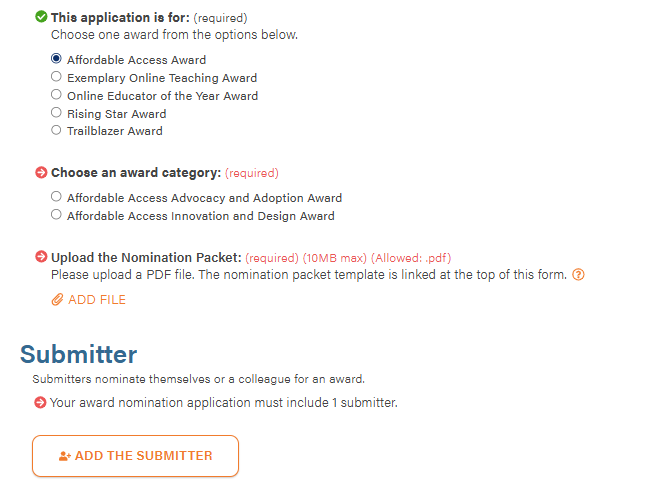
- Preview form questions
- Helpful Hints PDF for a Great Nomination Packet
- Download the nomination packet PDF
Application Window:
The nomination application for the 2026-27 awards cycle will go live on October 1, 2026. The nominations for all awards will close on January 31, 2027.
For questions about the requirements or award, contact Lupita Eyde-Tucker
Affordable Access Advocacy and Adoption
Catia S. Silva, PhD, Department of Electrical and Computer Engineering
Affordable Access Innovation & Design
Di Yang, Ph.D., Department of Geography
Affordable Access Advocacy and Adoption Award
Diba Mani, Ph.D.
Instructional Associate Professor
Diba Mani has experience teaching small- and large-enrollment undergraduate- and graduate-level courses in-person, hybrid, and fully online. Diba emphasizes the need for accessible courses and content for especially STEM students, recognizing the exceptional schedules these students tend to have. Thus, maximizing the development of skills alongside learning subject matter is an emphasis in her courses: she integrates internationalization and virtual exchange, scientific communication through presentation development, using artificial intelligence as a tool, and authentic assessments as much as possible.
Affordable Access Innovation and Design Award
Ricky Wayne Telg, Ph.D.
Lecturer
Ricky Telg is a professor in the University of Florida’s Department of Agricultural Education and Communication. In his agricultural communication, instructional technologies, and news writing courses, Telg integrates a hands-on approach to instruction that teaches students how to develop communication methods and digital media for the agricultural workplace. He has served as the director for the University of Florida/ Institute of Food and Agricultural Sciences’ (UF/IFAS) Center for Public Issues Education in Agriculture and Natural Resources (PIE Center) since 2016.
Affordable Access Awards
Matthew Traum, Ph.D.
Instructional Associate Professor
Jason Nowell, Ph.D.
Lecturer
Casey Rowe, Pharm.D.
Clinical Associate Professor
Affordable Access Awards
Ashish Aggarwal
Instructional Assistant Professor
Department of Engineering Education
COP2271: Computer Programming for Engineers
COP3530 Course Development Team
Team Lead: Amanpreet Kapoor, Instructional Assistant Professor
Department of Engineering Education
COP3530: Data Structures and Algorithms
Melanie K. Veige
Instructional Professor, Director of General Chemistry
Department of Chemistry
CHM1020: Chemistry for the Liberal Arts
Affordable Access Awards
Han Xu
Senior Lecturer
Department of Languages, Literatures and Cultures
College of Liberal Arts and Sciences
Kevin Jones, Ph.D.
Distinguished Professor
Department of Materials Science & Engineering
Herbert Wertheim College of Engineering
Sophia Acord, Ph.D.
Adjunct Associate Director
Center for the Humanities and the Public Sphere
College of Liberal Arts and Sciences